Mua Tho Cho Em 2012, Northern California Style! Recap

VNHELP hosted the first of two Mua Thu Cho Em fundraising concerts for this year on October 7th. The concert took place at the Santa Clara Convention to a packed house, with people of all backgrounds coming together to enjoy a night of culture and charity. See for yourself in the snapshot below!

Can you find yourself in the crowd?

Read More “Mua Tho Cho Em 2012, Northern California Style! Recap”

Vietnam’s Rising Inequality

Since Vietnam began opening up its markets in the 1980s, the country’s economy has and continues to experience rapid growth.  Economic reforms, coupled with aid from international agencies, have helped Vietnam reduce extreme poverty by more than three-quarters and hunger by two-thirds since 1990.  Furthermore, Vietnam’s GINI Index in 2008, a scale that measures national distribution of income (with 0 representing perfect equality and 100 signifying absolute inequality), ranked at 37.57, a slight improvement from 2006’s 37.77 and 2004’s 39.16.

As Vietnam’s gross domestic product (GDP) increases to $320 billion in 2012 from $280 billion in 2010, the number of millionaires in the country dramatically rises as well. In June 2012, the Central Institute for Economic Management (CIEM) reported its findings on income gap reduction in Asia for the first half of 2011.  CIEM revealed that the number of millionaires in Vietnam increased by 33% from the same period in the previous year. Official statistics from the Vietnam Stock Exchange in 2011 show the 100 richest people on the stock exchange market are worth over $2 million each, with two people qualifying for the United States’ $100 million CEO club.

However, as the number of Vietnamese millionaires increases and the market expands, the economic gap between rich and poor also widens.  Despite improvements in the GINI index, the proportion of population below poverty line in Vietnam actually increased from 12.3% in 2009 to 14.5% in 2010.   The monthly average income per capita by residence in 2010 was 2,130,000 VND ($102) in urban areas, with the top-earning regions being in the southeast (notably the Ba Ria-Vung Tau Province and Saigon [HCMC]) at 2,304,000 VND ($110).   On the other hand, rural areas averaged 1,071,000 VND ($51), with the lowest-earning northern midlands, mountains and coastal regions coming in at just 905,000 VND ($43).  The gap in income is reflected in spending as well, with the wealthiest spending 3.8 times more in healthcare and 6 times more in education than their poorer counterparts.

Read More “Vietnam’s Rising Inequality”

Vietnam Added to List of Countries with Child Labor Problems


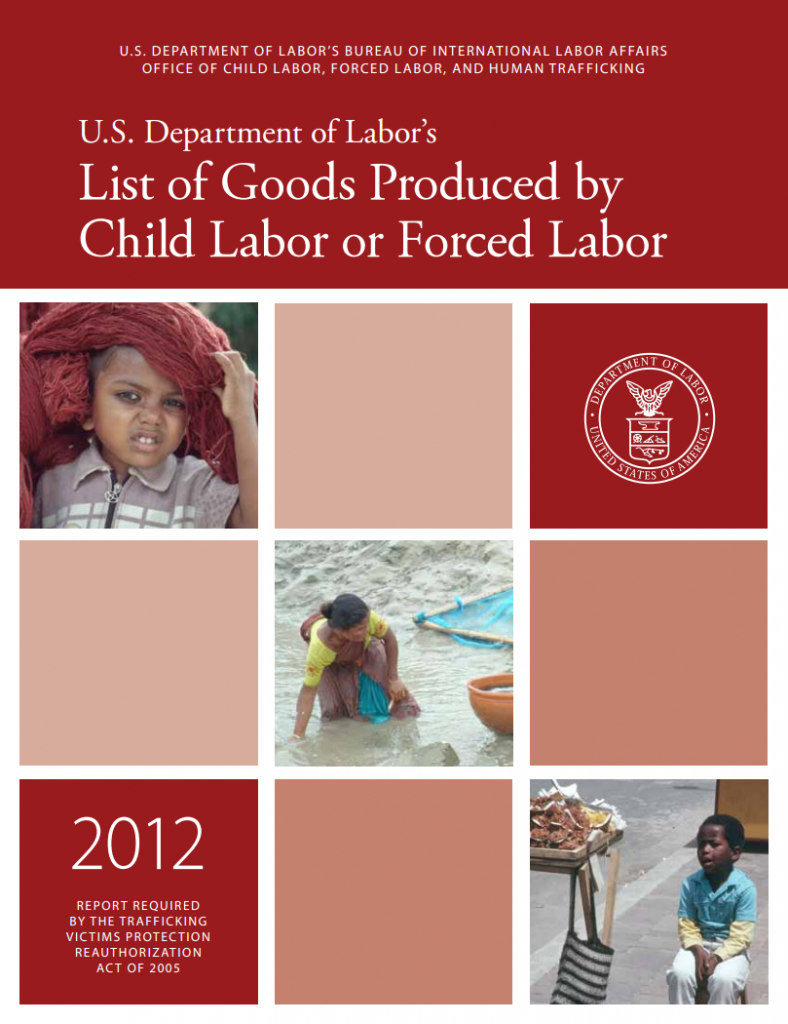
Today, the U.S. Labor Department released its annual assessment on forced labor and child labor across the world. For Vietnam, the results are grim. Along with South Sudan and Suriname, Vietnam has been added to a list of 74 countries that have serious child labor issues.

According to the report, products that could likely involve child labor in Vietnam include bricks and garments. Garment production may also involve forced labor.

Nearly all of the Southeast Asian countries, including Burma, Cambodia, Indonesia, Malaysia and Thailand, are included on the list, although the number of products with the risk of child labor production ranges in number.

The report is released in the midst of increased discussions on human trafficking following President Barack Obama affirmation that he would help clamp down on trafficking at the UN summit on Tuesday. Evoking the harshest of terms, Obama said:

It is a debasement of our common humanity. It ought to concern every community, because it tears at our social fabric. It ought to concern every business, because it distorts markets. It ought to concern every nation, because it endangers public health and fuels violence and organized crime. I’m talking about the injustice, the outrage of human trafficking, which must be called by its true name – modern slavery.


What Will It Take to End Poverty?

As the new president of the World Bank, Dr. Jim Yong Kim has been asking, “What will it take?”

That is, what will it take to end poverty when 1.3 billion people are living on less than $1.25/day. As Dr. Kim notes in this new video released by the World Bank, that’s 1 our of every 5 people in this world barely scraping by.

Vietnam fares slightly better with 17% percent of the population (a little under 1 in every 5 people) living at $1.25/day, according to the latest World Bank figures available. But when you inch that number up to $2/day, the proportion of the population living in poverty is nearly half at 43%.

So we’re just as curious as Dr. Kim. What do you think it takes to end poverty? Will it be in collective action and people combining resources for a common good? Will it be private sector growth and new job openings? Is it a world where everyone is an entrepreneur? How does the environment fit into the equation? Is it a combination of everything?

Watch Dr. Kim’s video below after the jump.

Read More “What Will It Take to End Poverty?”

Fundraising Update: OneVietnam Challenge Met

We’re ecstatic and grateful: thanks to our supporters, we met our OneVietnam challenge–and then some. With your donations, VNHELP is now one of the top three fundraisers on OneVietnam Network. These numbers and rankings change almost daily, so we don’t know how long we’ll be there, but we’ll enjoy it while it lasts. Will we ever get to the top spot? Who knows! But more important than an ranking is the fact that we have new funds to support our humanitarian and development projects in Vietnam. From money to connect poor households to clean water sources to scholarships for university students, you make it possible. Thank you!

Four Ways to Improve Your Diaspora Organization’s Fundraising Strategy

We published an article on the blog of the International Diaspora Engagement Alliance (IdEA) about diaspora philanthropy and fundraising! Check it out. Here’s a little snippet:

Philanthropic culture evolved in different ways in the East and West. The giving instinct for many Asians, particularly those from East Asia and parts of Southeast Asia, is often rooted in emotional ties to their homeland, Confucian values (duty to family and community) or religious traditions (compassion and generosity). For these reasons, many Asians aren’t compelled to institutionalize their giving as is done in the Western world.

Read the full article on the IdEA’s website.

VNHELP is Now on OneVietnam Network!

VNHELP is now on OneVietnam Network, a new crowfunding platform that enables you to easily donate to your favorite causes and receive timely updates on the projects you’ve helped support. Please check out our page at www.onevietnam.org/vnhelp! OneVietnam has challenged to reach 50 donations in one month–we’re currently almost half there at 21. Please help bring us to 50 and earn us a permanent spot on the network! We really appreciate your support, and the money we raise through OneVietnam will go directly into our projects to help the poor in Vietnam.

Thanks friends!


Infographic: How Do High Food Prices Affect the Poor?


Check out this new infographic from the UN”s World Food Programme which explains how high food prices are affecting the global poor.
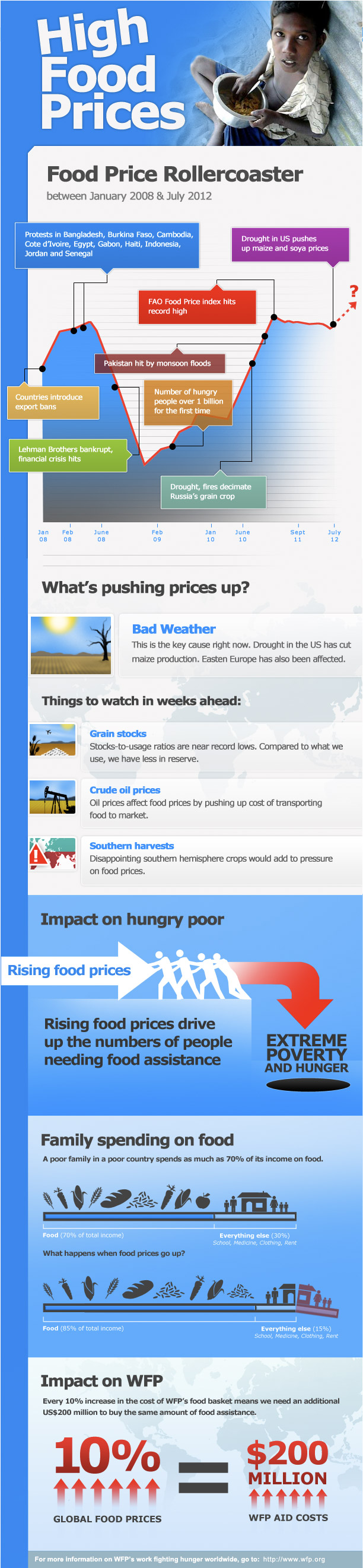
 

Note how some families must spend up to 70% of their income to meet nutritional needs, with the proportion raising up to 85% during times of inflating prices. This means that just 15% of income can be allocated to education, health, and other essential needs. Trade-offs are inevitable.

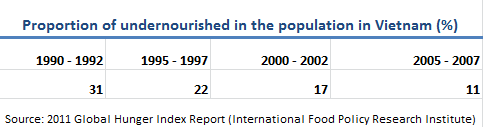
In Vietnam, food, prices, and hunger are complicated issues. Although many of us would like to think of Vietnam as a country abundant in cheap, delicious foods, the Global Hunger Index actually categorizes Vietnam as having “serious”  hunger problems. According to the International Food Policy Research Institute (IFPRI), which produces the Global Hunger Index, an average of 31% of Vietnamese were undernourished between 1990 – 1992. But just as Vietnam has been able to drastically reduce its poverty rates, it’s also been able to reduce the proportion of the population undernourished. Between 1995 – 1997, the average dropped to 22%, then 17% between 2000 – 2002, and 11% between 2005 – 2007.
Inflating food prices can also a carry an array of effects on Vietnam’s poor. THE IFPRI noted that increasing prices between 2006 – 2008 could have actually reduced poverty in Vietnam by 8% because the increase food prices benefited many rice farmers, who constitute Vietnam’s rural poor. On the flip side, a recent post on CNBC.com noted that China, Hong Kong, and Vietnam are the three Asian economies most vulnerable to soaring food prices. This, according to economists at Nomura, a financial management consultant firm, is because food prices make up a large portion of Asian countries’ Consumer Price Index (CPI), a measure that weighs the average price of basic  goods for a consumer.

Tai Hui, a head economist at the Regional Research for Asia with Standard Chartered, explained to CNBC that China, Hong Kong, Vietnam are particularly vulnerable to food inflation because their CPI baskets are highly correlated with global prices as measured by the CBR/Reuters Food Index, which have been increasing in the past three months: “Hui said for every one percentage point increase in the CRB Food Index, inflation in Vietnam, and China and Hong Kong goes up 13.7 basis points, 6.3 basis points and 4.9 basis points, respectively.”

For now, though, hunger in these three economies has not hit crisis levels. We’re hoping it remains that way–and gets better.